
A quick Porsche VIN warranty check gives you answers fast. See Porsche factory warranty, remaining coverage, CPO, or extended options in minutes - clear, reliable, and ready before a costly or unexpected repair. Using a best free vin check helps you validate the information and avoid unpleasant surprises.
What you’ll need:
- Vehicle identification number (your 17-character VIN).
- Current mileage and purchase date.
- Basic warranty paperwork, service records, and any classic technical certificate.
We’ll keep the process simple and transparent for every Porsche owner. This guide covers Porsche warranty by VIN, factory status, and remaining warranty, plus CPO and extended plans. It works for new, CPO, pre-owned and used vehicles, and it’s useful before a car purchase or when selling.
Why your warranty status matters:
Extended maintenance gets expensive. Comprehensive warranty coverage protects your budget, helps resale value, and brings peace of mind. Knowing when coverages expire lets you plan service and get the problem resolved before it’s out of scope.
Flow at a glance:
- Find the VIN → use official online tools → confirm with a seller → add context from EpicVIN/Carfax → consider a Porsche extended service plan if needed.
- Drop a quick Porsche VIN warranty check so your info stays up-to-date.
Porsche Warranty Basics and the Role of Your VIN
See how the core coverages work, how factory, CPO, and extended layers stack, and how your car’s unique identifier links every eligibility date and mileage limit to your specific build. These layers don’t just overlap by time; they’re structured to offer seamless protection as one ends and another begins. Understanding this structure helps avoid confusion when reviewing service history or discussing warranty status with a seller or dealership.
Types of Porsche Warranty (Factory, CPO, Extended)
| Type | Typical term & scope | Notes |
| New car/factory | The manufacturer's time and mileage limits | Starts at in-service date; standard warranties and exclusions apply |
| Porsche Approved / CPO | Added term after factory ends | Backed by Porsche; ask for the Porsche-approved warranty paperwork |
| Porsche extended service plan / Porsche Protection Plan (VSP, etc.) | Optional, can reach long terms | Sold by dealership or reliable seller; check terms and conditions |
- These layers can stack: factory → CPO → extended warranty.
- Major components differ by plan; read the specification and detailed information before you buy.
- All records live under your VIN in Porsche systems, tied to that serial number and the serial data.
Your Porsche VIN: What It Is and Where to Find It
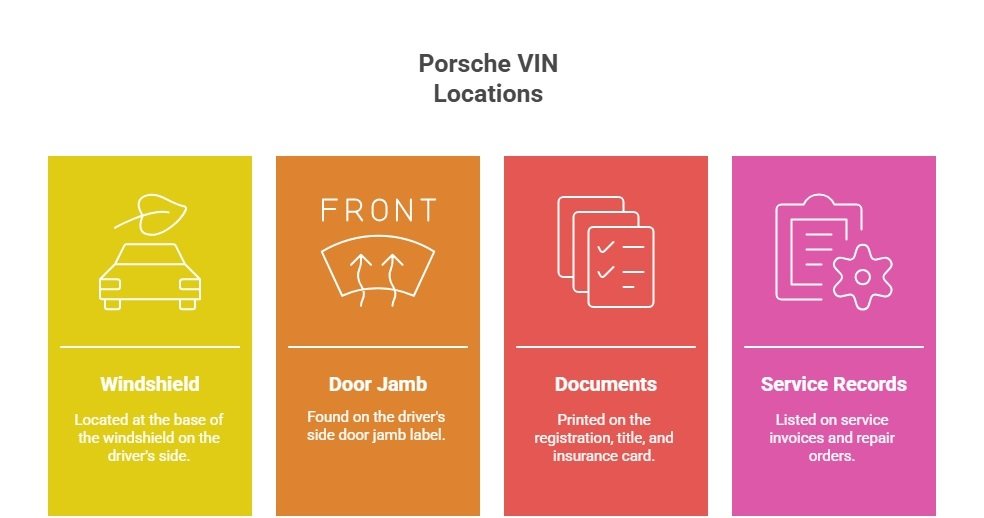
Your VIN is the vehicle identification number that anchors every warranty lookup and safety campaign search. It also powers a VIN check and other decode tools.
Where to look:
- Windshield base, driver side
- Driver door jamb label
- Registration/title and insurance card
- Service invoices
How to Check Porsche Warranty by VIN: Step-by-Step
You’ll confirm the vehicle, read dates, then examine coverage with an expert. Each step helps clarify whether your Porsche is still protected and what type of warranty may apply. Following the process also ensures accurate records before service, resale, or warranty extension.
Step 1 – Use the Porsche Recall Lookup to Validate Your VIN
Do this:
- Open the applicable recall page and enter your VIN.
- Review results: open safety campaigns, completed campaigns, or “no open safety campaigns.”
- Start here because it validates the VIN in Porsche systems.
Warning: Recall ≠ full warranty. Treat this information as safety data, not coverage dates.
Step 2 – Check Porsche Warranty Online via My Porsche / Porsche Connect
How-to:
- Log into My Porsche or Porsche Connect and add the car by VIN.
- Open Warranty and Vehicle information.
- Note the in-service date, start/end dates, and any CPO warranty details.
Step 3 – Confirm Porsche Warranty Status with an Authorized Dealer
An authorized Porsche dealer is the final authority on factory dates and extensions. Call a seller with your VIN and mileage.
Sample script:
- “Here’s my VIN and mileage. Please check my warranty, remaining term, any deductibles, and whether a plan requires me to confirm work.”
- Ask for factory, Porsche Approved/CPO, and any Porsche extended service plan end dates.
Have this ready: mileage, maintenance records, email for customer service to send a written summary. If a plan lists only original parts, request the plan specification.
Step 4 – Use Third-Party VIN Tools, EpicVIN and Alternatives
| Official sources | EpicVIN & alternatives (Carfax, VinInspect, NHTSA, NICB) |
| Data comes directly from the brand and its network; authoritative for coverage dates and eligibility. | Aggregates public and private databases for a broad history context (title brands, odometer readings, prior damage). |
| Shows in-service date and coverage milestones when available; seller can confirm specifics. | Estimates timelines and fills gaps with historical events that may not appear in brand portals. |
| Best for final confirmation of coverage and claim eligibility. | Best for due diligence before buying or negotiating. |
| Limitations: may require account access or a call; wording can be technical. | Limitations: not an official coverage source; occasional gaps or reporting delays. |
| Cost: usually free via portals; seller confirmation is free. | Cost: some reports are paid; federal sites (NHTSA/NICB) offer limited free checks. |
| Save: screenshots and seller printouts for records. | Save: full PDF reports and reference IDs for your file. |
Privacy tip:
- Use a private network and trusted devices when uploading paperwork.
- Redact home addresses or financial details before sharing reports.
- Create read-only PDFs; avoid posting a full VIN in public forums.
- Review each site’s data policy and opt-out settings before purchase.
Making Sense of Your Porsche Factory Warranty Status
With dates and mileage in hand, read which layer applies now. Warranty coverage doesn't always end when you think it does, and overlapping plans can add unexpected protection. Knowing how these layers interact helps you make smarter service and ownership decisions.
Is Your Porsche Still Under Warranty?

Here are a few short scenarios to see how the warranty works:
- New Macan, 22k miles: factory likely active if limits aren’t reached.
- Seven-year 911 with CPO: factory ended, CPO active until its term/miles.
- Older Cayenne with only an extended warranty: that plan remains; watch deductibles.
- If both limits are exceeded, coverage can stop, and claims may be void.
Key Dates and Numbers to Track Your Warranty Expiration
Track these:
- In-service date (start) and purchase date
- Expiry dates for factory, CPO, and extended
- Mileage limits vs current odometer
- Applicable warranty periods and remaining months/miles
Extended Coverage and 10-Year Porsche Protection Plans
| Feature | Factory warranty | Porsche extended service plan | Third-party service contract |
| Who backs it | Manufacturer | Porsche/participating retailer | Independent company |
| Typical term | Fixed years/miles from in-service date | Can extend to ~10 years/100k miles | Varies widely by provider |
| Covered items | Powertrain + stated components per booklet | Tiered levels; mirrors factory-style coverage on many systems | Highly variable; read the contract line-by-line |
| Deductible | Usually none | Often configurable (e.g., $0–$250) | Common; sometimes per visit/per component |
| Where you can service | Official network | Official network; may allow limited flexibility | May restrict shops or reimburse capped labor rates |
| Transferability | Generally transfers with the car | Often transferable (fee may apply) | Sometimes transferable; fees/limits common |
| Claims process | Streamlined at sellers | Similar to the factory through Porsche channels | Must follow provider steps; approvals can add time |
| Parts | OEM, genuine parts | Typically genuine/OEM | May allow aftermarket; check terms |
| Cost | Included in purchase | Upfront or financed; price varies by model/age/miles | Often cheaper upfront, but coverage can be narrower |
Tips to choose wisely:
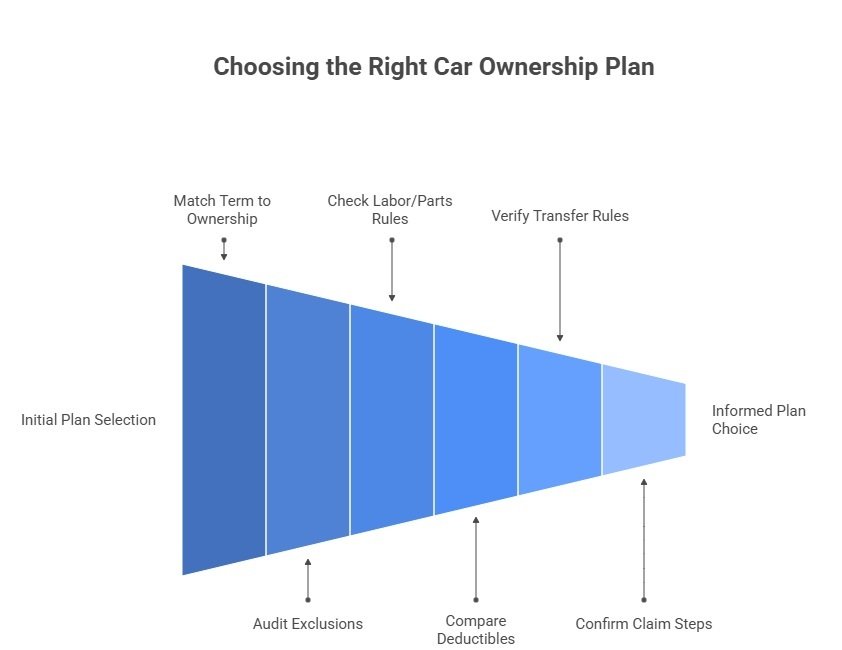
- Match term to ownership plan: Pick years/miles that fit how long you’ll keep the car.
- Audit exclusions: Brakes, trim, and “wear” items are usually out - confirm what’s listed.
- Check labor/parts rules: Prefer OEM parts and standard labor guides; avoid capped hourly rates.
- Compare deductibles: A lower deductible costs more upfront, run the math for your mileage.
- Verify transfer rules: If you may sell, a transferable plan can boost resale value.
- Confirm claim steps: Know whether pre-authorization or inspections are required.
- Get quotes from multiple sellers/providers: Prices are negotiable; ask for itemized coverage tiers.
- Keep paperwork: Save contracts, screenshots, and seller printouts so claims go smoothly.
PO Transfers, Used Cars, and Remaining Warranty
Factory coverage often transfers, and many CPO plans transfer when the paperwork is correct. Common used cars patterns: remaining factory coverage, sold as CPO, or none.
Buyer checklist:
- CPO certificate or seller printout
- Maintenance records and VIN reports
- Ask to certify coverage dates in writing
Case note: If anything conflicts, inquire before signing.
Using VIN-Based Warranty Info When Buying a Used Porsche
Step-by-step checklist:
- Run the VIN through the official NHTSA page to validate the car and note any open items.
- Log into My Porsche / Porsche Connect, add the car by VIN, and save warranty docs or screenshots.
- Call a reputable seller with VIN + current mileage to confirm active coverage and expiration dates - request an email summary.
- Pull a third-party report with a VIN decoder (EpicVIN/Carfax/VinInspect/NICB/NHTSA) for a Porsche vehicle history, title brands, odometer reads, and prior damage.
- Book a pre-purchase inspection (PPI) at a Porsche-experienced shop; ask for written estimates on any findings.
- Gather maintenance records, CPO doc, and the seller's printout; ensure names/VINs match.
- Compare coverage remaining vs projected ownership period and maintenance risk; decide if an extended plan makes sense.
- Align paperwork: purchase agreement, disclosures, and any transfer/activation forms for CPO or extensions.
Negotiation tips:
- Short remaining coverage or no CPO? Use the cost of an extended plan as a price lever.
- Missing service records or incomplete recall closures? Ask for a price reduction or completion before the sale.
- PPI found issues? Negotiate maintenance at a Porsche-capable shop or deduct the written estimate from the price.
- Transfer fees/deductibles on plans? Request that the seller cover them or adjust the offer.
- Grey-market import or inconsistent history? Walk away or price in a higher risk.
- Near warranty expiration? Push for an immediate seller recheck and an on-paper out-the-door adjustment.
Risks, Exclusions and Owner Protections
Before you rely on coverage, understand what’s excluded, how maintenance and modifications affect eligibility, and what steps to take if a claim is denied, so you can protect yourself and your budget.
What Porsche Warranties Don’t Cover and Common Mistakes
Exclusions:

- Wear items, cosmetic damage, accidents, and misuse.
- Failures from non-approved parts or tuning, genuine Porsche parts are missing.
Do this instead:
- Follow schedules
- Ensure receipts are kept
- Discuss mods with a seller first
- Stick to car manufacturer specs.
When Your VIN Shows “No Data” or Conflicting Warranty Info
Troubleshoot:
- Recheck the VIN from multiple spots; it’s your serial number
- Try other regional sites; contact Porsche customer service
- Ask a dealer to escalate and provide written proof
Red flags:

- Mismatched year/model
- Odometer anomalies
- Frequent ownership changes.
If needed, ask for a classic technical certificate and an overview of all the applicable campaigns to get the problem resolved.
Your Legal Rights and Consumer Protections (US Overview)
Quick hits:
- Magnuson–Moss, state lemon laws, and NHTSA oversight on safety.
- Odometer fraud and title washing harm both lookup accuracy and real coverage.
This is general automotive info only; consult an attorney for your disputes.
Frequently Asked Questions
Find your 17-character VIN on the car or paperwork, then run a lookup and check your car through the My Porsche or Porsche Connect account. Finally, call an authorized dealer and ask them to confirm your warranty, any CPO coverage and any extended service plan on that VIN.
Start with the official Porsche recall information page and enter your VIN to confirm the car and see campaigns. Next, log into My Porsche or Porsche Connect to view warranty docs, then use that information to double-check your remaining warranty with a dealer by email or phone.
The “10-year warranty” usually refers to optional Porsche extended service plans or a Porsche Protection Plan that can cover key components for up to about 10 years or 100,000 miles. These plans are purchased separately and extend coverage beyond the standard new car warranty.
In most regions, the factory new car warranty automatically transfers with the car, and many Porsche Approved/CPO warranties can transfer when the paperwork is done correctly. Before you buy, ask a Porsche dealer to verify Porsche CPO warranty details and remaining coverage for your VIN.
Normal wear items like tires, brake pads and wiper blades, cosmetic issues, accident damage and failures caused by non-approved modifications are usually excluded. Warranty claims can also be rejected if you miss scheduled services or cannot prove proper maintenance with receipts.
Compare your in-service date and current mileage with the time and mileage limits listed in your warranty booklet or dealer printout. If either limit is exceeded and no CPO warranty or extended service plan is active on your VIN, your warranty expiration date has passed and coverage has ended.
Extending coverage with a Porsche extended service plan typically costs several thousand dollars over the term, depending on model, age, mileage and coverage level. Dealers often have room to negotiate, so it’s smart to request quotes from more than one Porsche dealer and ask them to match the best offer you get.
It can be valuable if you plan to keep the car for years and want protection from high-cost repairs, especially on complex models like the 911, Panamera or Taycan. If you change cars frequently or the price of CPO or an extended plan approaches the likely repair risk, you may prefer to self-insure instead.