

To transfer car ownership, the seller signs over the title to the buyer. The buyer submits the signed title to the state DMV within the deadline. Most rejections happen because the VIN, odometer, or lien release information is missing or doesn’t match.
Quick Tip:
- Verify the title.
- Sign correctly.
- File with the DMV.
- Keep receipts so the buyer can register and insure the car.
Core Concepts of Car Ownership Transfer Explained
A transfer is the official change in ownership recorded by the state, updating vehicle records. Taxes, liens, and tickets follow the person shown on the title, not the person holding the keys. Most delays come from missing fields or mismatched VINs. Thus, both sides should slow down. Keep copies because they prove when the transfer of ownership happened.
- The title is proof of ownership and shows lien status.
- Sellers and buyers fill in the date, price or gift value, and mileage.
- The buyer files a transfer of title application and pays fees at the state office.
- The state updates the record, and the car is transferred to a new owner.
- The state prints a new title for the new owner.
What Is a Car Title and Why Does It Matter for Ownership Transfer?

A title, also called a certificate of title, proves who owns a car, and you usually need a title to register it. The title lists the owner, the VIN, and any lienholder that must release interest before transfer. Before you buy a car, compare the paper to the car and pull a vehicle history report to check branding and mileage. A clean paper trail also helps you price a used car correctly. Here are the essential parts of a car title:
- Owner details as shown on the title.
- VIN, year, make, and model for the car.
- Lienholder line and release area.
- Odometer disclosure (if required).
- Signature blocks for signing the vehicle title.
Required Documents for a Valid Title Transfer
To complete the title transfer, bring the original title, a bill of sale, and photo ID. Many states also require insurance proof, emissions paperwork, and an extra state form. These documents help the DMV confirm that the vehicle legally belongs to the seller, that the buyer is properly identified, and that the car meets state safety or environmental requirements. If your state follows federal REAL ID standards, your ID must comply with the REAL ID Act regulations established by the Department of Homeland Security. Preparing these items before the handoff also ensures that both parties can complete the transfer in one visit without delays.
Seller Documentation Rules & Liability Protection
When you sell your car, especially when selling a used car, treat the title like a legal document. Confirm your name matches the title line. Make sure the VIN on the car matches the paper. Before you complete the car sale, sign the title to release and hand the title over to the buyer. Keep copies of the completed paperwork and bill of sale. If you are selling the car privately, file the release notice with the local DMV; these steps fit selling or gifting a car.
| Seller item | Why it matters | Keep a copy? |
| Must sign the title in the seller's area | Prevents rejection | Yes |
| Title to the buyer plus bill of sale | The buyer can file the title application | Yes |
| Lien release (if needed) | Proves the car can be sold | Yes |
| Release of liability submission | Stops tickets tied to your name | Yes |
| Update car insurance after handoff | Avoid paying for a car you sold | Yes |
Buyer Documentation Requirements & Fraud Prevention
As a buyer, confirm that the person selling the vehicle can legally transfer a title. Match the VIN on the car to the paper and check for missing fields. Avoid a car without a title; if someone says it’s “coming later,” don’t pay - everything else is risk. If a co-owner is listed, you may need to sign the title in both boxes. For mileage, make sure the odometer value is recorded accurately and disclosed as required under the Federal Odometer Law.
- Match the VIN on the dash and door label to the title.
- Get a bill of sale with both names, date, and price.
- Bring insurance so you can register the car right away.
- Ask about notarization or inspections.
Step-by-Step: How to Transfer Car Ownership (Seller vs Buyer)
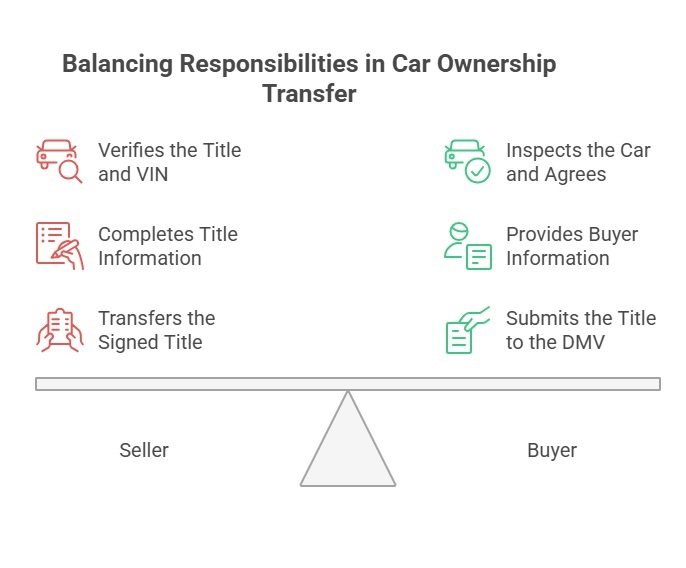
If you transfer a title in a rush, small errors can send you back to the motor vehicle office. This is transferring ownership of a vehicle with paperwork. The seller brings the title, ID, and lien release. The buyer brings ID, payment, and insurance. Use a VIN decoder to confirm that the trim and engine match the paper on an older used car.
- The seller checks that the title is clear or that the release is attached. They also confirm the VIN matches the car’s title.
- The buyer inspects the car and agrees to buy it at the stated price.
- Seller and buyer fill in date, mileage, and buyer info; to transfer means no blanks.
- The buyer takes the signed title and bill of sale.
- Submit the signed title to the DMV with the title transfer form and fees, then apply for a new title.
Total Cost of the Title Transfer Process
| Cost Component | Amount Type | Who Pays | When Paid | Typical Range |
| Title fee | Flat fee | Buyer | At filing | $15–$100 |
| Sales tax | % of vehicle price | Buyer | At filing | 2%–10% |
| Registration fee | Flat fee | Buyer | At filing | $30–$300 |
| Plate/validation | Flat fee | Buyer | At filing | $10–$80 |
| Title transfer fee | Flat fee | Buyer | At filing | $5–$50 |
| Notary | Flat fee | Buyer/seller | At signing | $5–$20 |
| Inspection/emissions | Flat fee | Buyer | Before filing | $0–$80 |
How to Estimate Your Final Cost
Add title and registration fees first, then add sales tax based on the purchase price. Include inspection, notary, and county charges. Use a state fee calculator if available, and confirm whether a lender will file for you. Also, check whether your state applies a minimum taxable value for older vehicles. Some states tax based on a standard value rather than the actual sale price. Reviewing your state’s official fee schedule helps estimate the final amount more accurately. For example, many states publish breakdowns of title and registration fees, such as the California DMV’s official fee schedules.
State-Specific Title Transfer Rules
Title transfer requirements vary because each state uses different checks. Some states require notarization, others require emissions testing, and some require fast filing. For out-of-state deals, transferring the car may require a VIN inspection. Always confirm what your state requires before you transfer the vehicle title to keep a clean title on a car. Check title transfer requirements before you go.
States requiring notarization:
- Arizona;
- Kentucky;
- Louisiana.
States requiring emissions:
- California;
- Colorado;
- Texas (selected counties).
States with strict deadlines:
- California (often 10 days);
- Texas (30 days);
- Florida (deadlines vary).
Technical Verification: Checklist to Prevent DMV Rejections
Scenario: You’re selling an older car and worry that mismatched VINs or missing emissions certificates could stall the title transfer. To avoid delays, confirm that identifiers and paperwork match before inspection.
- VIN consistency: match the dash plate, door label, and the title VIN digit by digit.
- Odometer: fill the field correctly or mark exempt where allowed.
- Emissions certificate: verify it’s current if your county requires it.
- Lien section: confirm releases are attached and readable.
- Listed on the title: verify every owner line is correct and signatures match.
EpicVIN notes that 29 states require emissions testing for registration in some form.
Critical Mistakes That Cause Title Transfer Rejections
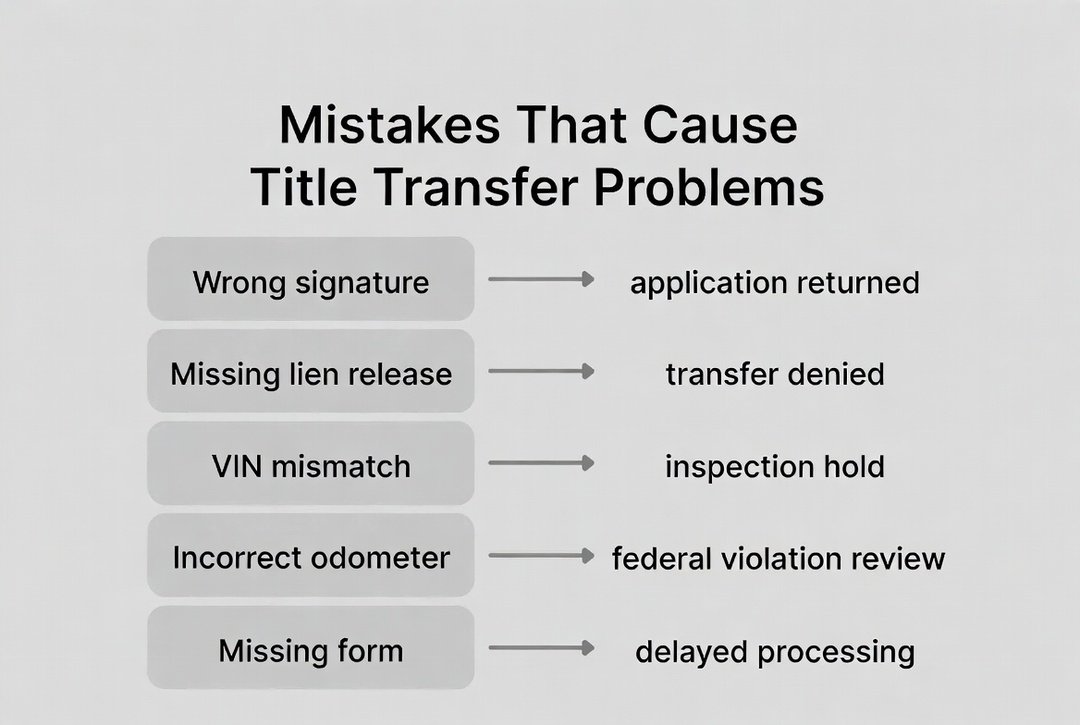
DMV rejections usually come from missing fields, altered ink, another mismatch, or wrong identifiers. A cross-out can force a duplicate title and delay the transfer. If the file involves a salvage title vehicle, some states add inspections before they accept it.
Wrong VIN digit or VIN plate that doesn’t match the title.
- Odometer left blank when required.
- Missing lien release for a listed lender.
- The seller or buyer name doesn’t match the ID.
- Correction fluid, scribbles, or altered dates.
- Buyer info missing, unreadable, or incomplete.
Comparing Transfer Methods: DMV vs Tag Agency vs Dealership
| Transfer Method | Estimated Processing Time | Accuracy Level | Cost Level | Best For |
| DMV | Medium | High if the paperwork is clean | Low | Simple private sale or gift |
| Tag agency | Fast | Very high | Medium | Busy buyers and tricky titles |
| Dealership | Fast/medium | High | High | Financing, trade-ins, and new car deals |
Which transfer method should you choose so you don’t lose time and don’t make mistakes? Use the DMV if the paperwork is clean. Use a tag agency if the title has a lien release, a misspelled name, or a title to a family member.
California’s DMV says many ownership changes must be reported within 10 days.
Special Scenarios: Gifting and Inheritance

To gift a car, you still need to transfer a title; it’s common to pass it to a family member. A car to a family member may reduce tax, but a family member will need ID and signatures. For inheritance, a deceased owner may require executor papers. Ask if the car title of a family member can move ownership to a family member without probate.
After Submission: What Happens to Your Title?
Once accepted, the state will issue the new record, update registration and title, and send the title to the new owner by mail unless a lienholder holds it. During this stage, the DMV verifies all paperwork, matches the vehicle details against state databases, and confirms that no outstanding liens or compliance flags remain. The processing time varies by state, but most offices complete these checks before generating the updated ownership record.
What to Do If Your Title Is Delayed
If you expected the title as soon as possible, but it’s late, confirm that the payment cleared and that your address is correct. Missing signatures, expired emissions certificates, or lien issues can pause processing. Call the local title office or visit the DMV office with your VIN and receipt number. Ask if your title in the mail was returned.
How to Track Your Title Status Online
Most states offer online tracking once you submit the paperwork. Enter the owner's details exactly as on the title. If the status shows “hold,” it usually means one missing document. When it shows “issued,” you should soon get the title.
- Find the “title status” page on your state DMV website.
- Enter VIN and name exactly as shown on the title.
- Save the confirmation and case number.
- Use the portal to get the title.
Key Takeaways
- A vehicle title is the legal proof of ownership, and the transfer isn’t complete until the DMV updates its records.
- Always verify the VIN, signatures, and lien status before signing the title. Most transfer delays come from mismatched identifiers or missing lien releases.
- Prepare all required documents in advance (title, Bill of Sale, odometer disclosure, state application forms) to avoid DMV rejection or repeat visits.
- Buyers should calculate the full transfer cost early, including sales tax, title fees, registration charges, and any emissions or county add-ons.
- Sellers must protect themselves by filing a Release of Liability and keeping copies of the signed title and paperwork.
- State-specific rules, like notarization or emissions testing, can change the steps required, so always check your state DMV’s guidance before filing.
- Track the title status after submission and respond quickly if the DMV requests corrections to prevent processing holds or penalties.
Frequently Asked Questions
Yes. Bring proof linking the old name to the current name. This may be a marriage certificate or a court order. The DMV may ask you to change the title first or attach the document during the transfer.
Some states allow the paperwork step. However, they won’t let you register the car until the smog is complete.
- If your state requires emissions, test before filing.
- If exemptions apply, bring proof to the DMV.
- Ask whether a car for a family member qualifies for an exemption.
For a new vehicle, you use the manufacturer’s origin statement, bill of sale, and ID to apply for a title. The DMV verifies the VIN and issues a new title once taxes and fees are paid.
Usually, no; you can’t complete the transfer of title without a release.
- Request a payoff and lien release from the lender.
- Ask the DMV about bonded title steps if the lender is gone.
- Don’t finalize the sale until the lien is cleared.
Many clean submissions take 2–6 weeks, but corrections and busy seasons extend that. Keep your receipt and temporary papers until the updated title arrives, and follow up if online tracking shows a hold.