
Motorcyclists face a far greater risk of fatal crashes than car occupants, even when driving conditions are the same. Based on the most recent full-year data from the National Highway Traffic Safety Administration, the fatality rate for motorcyclists was 31.39 deaths per 100 million miles traveled, compared to 1.13 for passenger cars. That makes riding a motorcycle nearly 28 times more deadly per mile than driving a car. This article unpacks the data, explains why the gap exists, and what it means for drivers, riders, and policymakers. A free vin search can also play a role in rider safety by helping buyers review a motorcycle’s background, specifications, and potential red flags before getting on the road.
How Crash Rates Are Measured and Compared
Agencies compare accident risk by exposure. This is per registered vehicles, per licensed operators, and per 100 million vehicle miles traveled. Per-mile percentage is better because it reflects how far people actually go. Injury and fatal accident rates climb with speed, impairment, and visibility issues. A motorcyclist has little around the occupant to absorb energy. The gap persists even when conditions appear similar compared to car travel.
- Fatalities and injuries per 100 million miles, split by road class and light conditions.
- Rate differences for motorcycle accidents compared to car crashes.
- Helmet laws, helmet use, training, and licensing status indicators.
- Urban versus rural exposure, and seasonal effects on the number of accidents.
Motorcycles are a small share of registrations. However, they make up roughly 15% of U.S. traffic deaths.
How Safety Risk Differs Between Motorcycles and Cars
A motorcycle lacks crumple zones and airbags. The event of a crash transmits forces to the rider. Four-wheeled vehicles provide more protection to the occupant through belts, airbags, and structure. Visibility explains why a motorcyclist is more likely to be injured. Bikes present a small frontal area and vanish in traffic glare. These realities reflect core differences between motorcycle and car design. The severity of accidents diverges even at similar impact speeds.
| Metric | Motorcycles | Cars (passenger vehicles) | Takeaway |
| Fatalities per 100M miles | Far higher | Lower | Riders are times more likely to die per mile. |
| Urban intersection share | High | Moderate | Turning conflicts harm riders. |
| Protection systems | Gear, ABS | Belts, airbags, crumple zones | Cars provide more protection in comparable impacts. |
| Injury likelihood | High | Lower | Riders are more likely to be injured. |
Motorcyclists form a smaller fleet. Nevertheless, their exposure to kinetic energy per mile is intense. This explains the elevated harm profile.
Single-Vehicle vs Multi-Vehicle Incidents
A single-vehicle motorcycle accident often involves several issues. These are the loss of control, roadway departure, or a fixed object. Multi-vehicle incidents frequently stem from turning conflicts with car drivers who misjudge approach speed or gaps. A motorcycle is harder to detect in cluttered visual scenes. Going to perform a reconstruction of a motorcycle and car accident? Consider watching the video, collecting data, using a reliable motorcycle VIN check tool, and conducting scene surveys. The accident can be more complex when human and roadway factors interact.
| Breakdown | Motorcycles | Cars |
| Single-vehicle share of fatalities | Substantial | Lower |
| Multi-vehicle at intersections | High | Moderate |
| Fixed-object collisions | Meaningful | Lower proportion |
| Run-off-road severity | High | Lower with restraints |
In many two-vehicle motorcycle cases, the rider is struck in front by a turning vehicle, a pattern that dominates urban totals.
When and Where Crashes Happen Most Often

Motorcycle accidents occur most often in warm months. They happen in metro corridors with heavy turning volumes. Urban arterials, driveways, and signalized intersections create conflict points. Night conditions heighten danger with reduced conspicuity. Rural curves still produce severe run-off-road events, but urban exposure drives counts where car and motorcycle accidents cluster.
Which States Have the Most Motorcycle Crashes?
The largest number of motorcycle accidents tends to cluster in warm states. Florida, Texas, and California typically lead counts. Arizona or Pennsylvania are close behind in some years. But counts are not risk: smaller states can post higher per-mile motorcycle accident rates even with fewer events.
- Big metros generate more multi-vehicle accidents involving turning traffic and failing gap judgments.
- Long seasons expand exposure hours for motorcycle riders.
- Enforcement and motorcycle safety programs shift outcomes year to year.
Mechanical Failures That Lead to Crashes
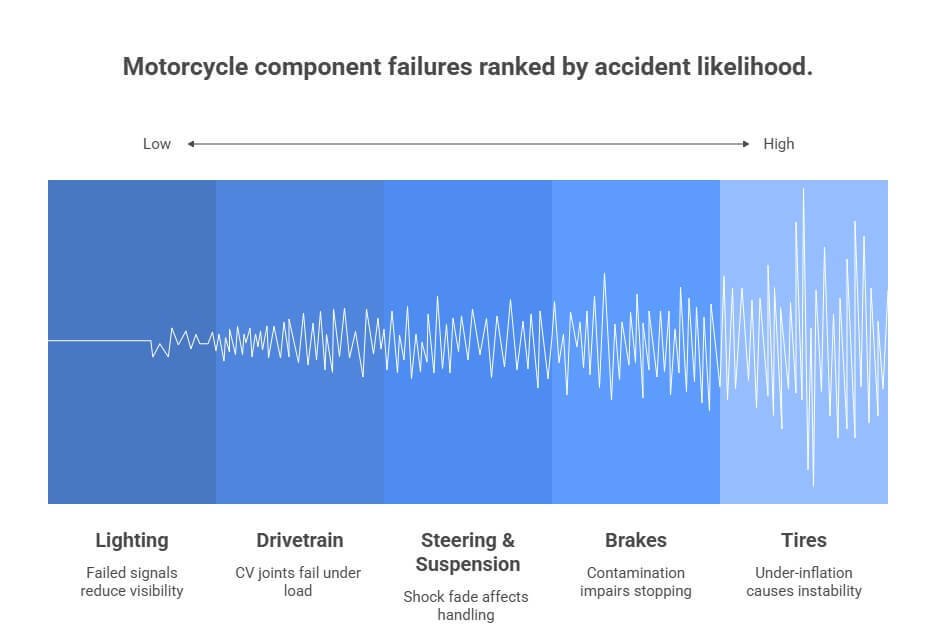
Mechanical problems are less common than human error. However, they still matter. On a motorcycle, a front-tire failure or seized caliper can create instant instability. In four-wheeled vehicles, hydraulic faults and blowouts remain common types of defect-related collisions. Regular maintenance can help reduce the number of accidents.
- Tires: under-inflation, aging rubber, punctures, and mismatched profiles.
- Brakes: contamination, seized pistons, and ABS faults. Cars add fluid leaks and rotor cracks.
- Steering & suspension: head bearings, fork alignment, shock fade; cars face tie-rod or control-arm failures.
- Drivetrain: chain stretch or snapped links; automotive CV joints fail under load.
- Lighting: failed signals and lamps reduce conspicuity, so motorcycle accidents happen in turning conflicts.
The Role of Rider and Driver Behavior
Human factors are the common causes of motorcycle accidents, and car accidents remain a public health problem. Speeding, impairment, distraction, and scanning errors are the leading causes of car accidents and many motorcycle accidents. Unlicensed riding and minimal training worsen results. Coaching motorcyclists and car drivers to anticipate left-turn conflicts and maintain space can shift outcomes markedly.
- Speeding multiplies energy transfer in any motorcycle or car accident and shrinks reaction windows.
- Left-turn violations by car drivers are a cornerstone of common causes in multi-vehicle scenarios.
- Alcohol and drugs impair balance and reaction time, central to the causes of motorcycle accidents resulting in fatalities.
- Advanced training for an experienced motorcycle rider improves hazard prediction and control.
How Technology Has Changed Motorcycle and Car Crash Risk
Technology helps, but physics still rules. ABS, traction control, and stability aids limit specific failure modes and improve braking on marginal surfaces. In cars, advanced driver-assistance suites cut many accidents before contact. On bikes, conspicuity upgrades like LED running lights help detection. Connected maintenance logs and a vehicle history report can surface unresolved recalls that quietly raise risk.
Safety Features and Protective Equipment: What Really Helps?

Three layers of safety matter. Here are they: avoid the impact, keep traction, and protect the body. Quality tires and ABS prevent lockups. Reflective gear and daytime running lights make you visible. Armor and airbag vests cushion falls. In a motorcycle accident, external protection substitutes for what a car provides internally.
- Full-face helmets and consistent helmet use cut head-injury odds and mortality risk.
- ABS and traction control preserve steering during emergency inputs.
- Hi-viz apparel and auxiliary lighting counter “looked-but-failed-to-see” errors.
- Airbag jackets and armored gloves moderate chest and extremity trauma for a motorcyclist.
Legal Consequences After a Crash
Fault analysis turns on negligence. This concerns speed, distraction, impairment, right-of-way, and maintenance. A motorcycle accident often yields complex injuries. A car’s structure protects passengers better. Evidence can include videos, service logs, and a VIN decoder report. Consider checking a motorcycle’s VIN for free if you are not sure about the current condition of your vehicle. Preserve gear, dash-cam files, and medical records if involved in a motorcycle accident or a car collision; timeliness matters for claims.
| Legal topic | Motorcycle focus | Car focus |
| Duty of care | Conspicuity, lane position, and intersection scanning. | Yielding, signal compliance, and distraction. |
| Comparative fault | Speed vs. turn violations are weighed together; accidents frequently involve both parties. | Phone use and following distance were reviewed. |
| Evidence | Helmet-cam, ECU logs, service records, VIN decoder outputs. | Event data recorders and telematics. |
| Injury patterns | External trauma; riders are injured more often compared to car occupants. | Restraints mitigate peak loads for car occupants. |
Summary
The motorcycle offers agility but exposes riders to harsher physics in an accident. Harm per mile stays lower in cars due to their structure and restraints. Better visibility, training, maintenance, and protective gear remain critical. Targeted enforcement and technology help manage everyday risk. Unlike cars, motorcycles are more affected by minor surface hazards like gravel, wet paint, or uneven pavement, which can quickly lead to loss of control. The absence of physical barriers also means riders rely more heavily on their own skills and gear for protection.
Frequently Asked Questions
Both benefit. ABS prevents wheel lock and preserves steering; on bikes, it trims loss-of-control events, while in cars, it pairs with stability control that averts many car accidents before contact.
Insurers price risk from motorcycle statistics, local density, theft patterns, rider age, and bike type. A motorcyclist with advanced training and ABS may pay less. However, high regional severity keeps premiums elevated for motorcycle coverage.
Yes. Single-track dynamics amplify small faults. So, a motorcycle rider’s tire or bearing issue escalates fast. Cars have redundancy, which makes bikes more sensitive to maintenance and surface defects in a motorcycle accident.
Urban intersections and multilane arterials load networks with turning conflicts. Rural two-lane curves elevate run-off severity. Access corridors with frequent driveways concentrate conflict points where accidents occur.
- Urban intersections and dense arterials.
- Rural curves with limited shoulders.
- Driveway-rich commercial corridors.
Evidence is emerging. Instant torque can magnify throttle errors, yet fewer moving parts may cut accidents due to mechanical failure. Training, ABS, and conspicuity remain decisive for a motorcyclist regardless of powertrain.