of checked vehicles carry a salvage-title record (last 30 days)
Top model years last 30 days
11%
2026
10%
2023
8%
2016
6%
2021
6%
2019
What is a Vehicle Identification Number in South Carolina?
A vehicle identification number (VIN) is a unique 17-digit code assigned by the manufacturer to identify a vehicle throughout its life. This number works like a vehicle’s serial number and helps connect the car, truck, or motorcycle to important vehicle records, including manufacturing data, title information, and service-related history.
When you run a VIN lookup SC, the sequence can help you access a vehicle history report with key details about the car’s background. That can include title data, collision history, ownership changes, and other information that matters before buying a used car. A South Carolina VIN lookup is especially useful when you want to review a vehicle’s past and spot potential hidden issues before making a decision.
How many digits are in a VIN?
A vehicle identification number is a 17-digit code made up of numbers and capital letters. Each character has a
purpose, including identifying the manufacturer, model year, assembly plant, and other production details. The
VIN also includes a check digit used to help verify that the number is valid.
Because every VIN is unique, it can be used in a VIN number check to confirm that the car
information matches the vehicle itself and the available history records.
How is a VIN number used?
You can enter a VIN into a VIN decoder whenever you want to learn more about a car,
whether you already own it or are considering buying it. A report generated from the VIN may pull data from
public and commercial sources, including legal records, government records, insurers, and insurance companies.
A South Carolina VIN lookup can return useful vehicle information:
Vehicle specifications.
Manufacturing details.
Ownership transfer history.
Reported accidents and damage history.
Repair history.
Past odometer readings.
Title brands.
Theft and salvage-related records.
This is one of the simplest ways for used-car shoppers to compare what a seller says with what the available
records show.
What is a Vehicle History Report in South Carolina?
A vehicle history report summarizes essential details about a vehicle from the time it was built through later
ownership and use. It may include title status, accident history, repairs, recalls, sales activity, and other
vehicle records tied to the VIN.
Depending on the provider and available data, the report may also include previous owners, junk or salvage title
records, insurance loss records, odometer readings, stolen vehicle check results, market value information,
recall notices, and possible airbag deployment records. Reviewing a report before buying a used vehicle can help
you understand the car’s background and identify problems that may not be obvious from a visual inspection
alone.
How to find your car’s VIN number?
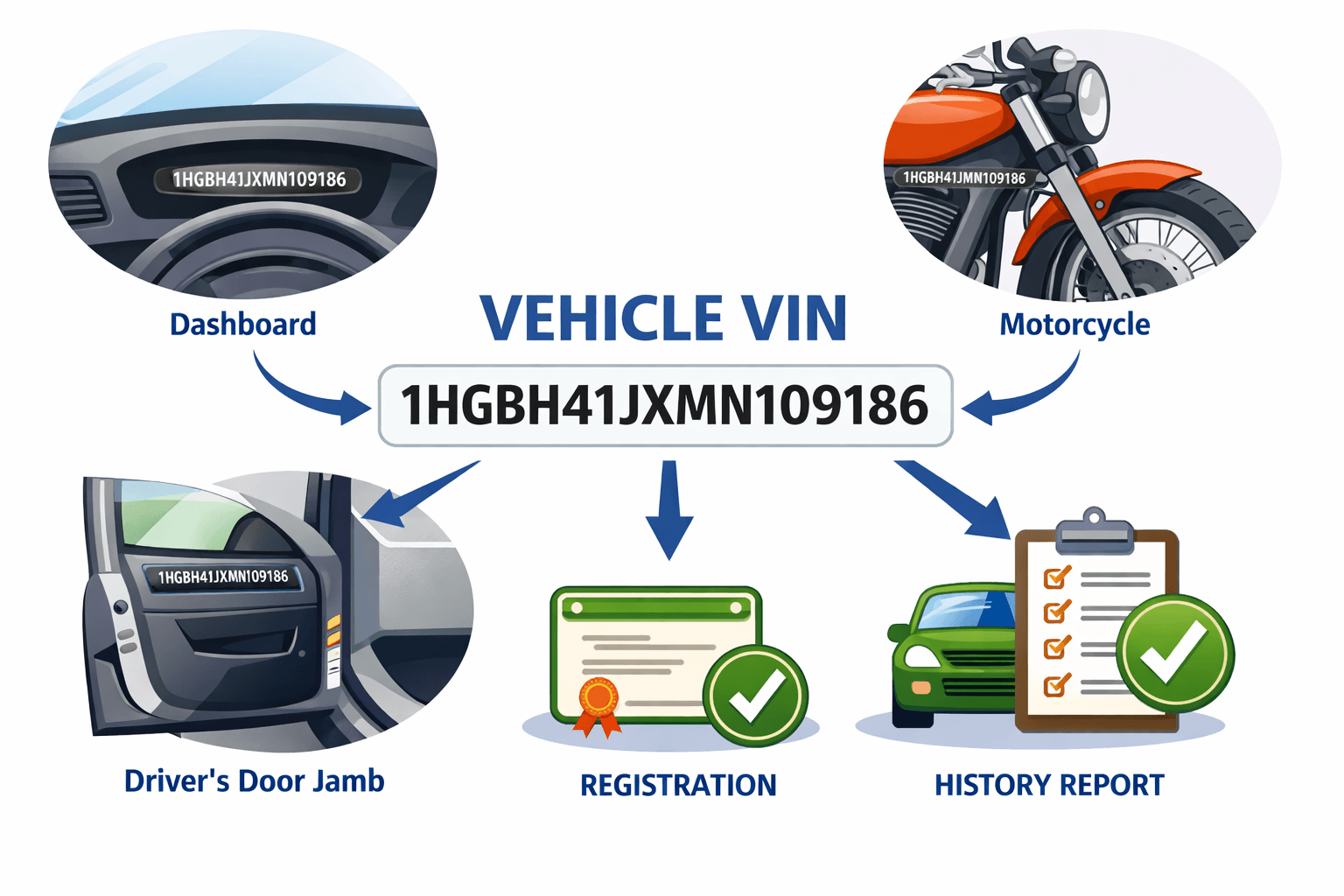
The VIN is usually located on the driver’s side dashboard, visible through the windshield. It can also be found
on the driver’s side door jamb. The sequence is usually mentioned in the vehicle paperwork: title, insurance
card, and registration card. On a motorcycle, it’s located on the steering neck or engine area.
Checking the VIN in these locations helps you confirm that the number matches the title, insurance documents, and
vehicle registration records before you run a report.
How to conduct a VIN Lookup in South Carolina?
To perform a VIN lookup, enter the full VIN into a decoder or lookup tool. A South Carolina VIN lookup can help
you review history tied directly to that specific vehicle, including ownership, title status, mileage, and
reported damage.
In some cases, you can also use a license plate number through a South Carolina license plate lookup tool. A plate-based search may be useful when the VIN is not immediately available, but a
VIN-based search is generally better when you want records tied to the exact vehicle and want to verify that the
documentation matches the physical car.
How do I look up a VIN number for free in South Carolina?
To run a free VIN search, enter the vehicle’s VIN into a VIN decoder. A free search may provide basic identifying
details and limited history indicators, while a more complete report may include deeper data on title status,
accidents, mileage, and ownership records.
If you want a VIN check before buying, free results can be a good starting point, but a fuller report usually
gives better context for evaluating risk.
Why should I run a South Carolina VIN check?
A VIN check helps you review vehicle records before you buy, sell, or register a car. It can reveal title
history, ownership data, and other record details that help you better understand the vehicle’s background.
It can also help uncover collision history, flood damage, and mileage issues that may not be obvious in person.
That makes it easier to spot hidden problems and make a safer buying decision.
South Carolina Resources for Car Drivers and Owners
Why are VIN checks so important in South Carolina?
A VIN check can help you verify whether a vehicle’s records match its condition and seller description. Depending on the available data, the report may show odometer readings, lien information, title branding, accident and service history, and alerts related to odometer rollback.
This can be especially helpful when shopping for a used car, because records may reveal hidden accident history, prior damage, or signs of odometer fraud that would otherwise be easy to miss.
Where do I get a VIN Check in South Carolina?
You can get a VIN check through EpicVIN’s VIN decoder. When available, the report may combine data from public sources, insurers, government databases, and related records to give you a clearer picture of the vehicle.
A practical SC VIN check can help you review history, theft records, recalls, title status, and vehicle specs in one place before you commit to a purchase.
Frequently Asked Questions
You can start by entering the VIN into a free decoder. Basic results may show identifying details and limited record summaries, while paid reports often include more complete information on accidents, title status, mileage, and ownership history.
A VIN can reveal core identifying and manufacturing details about a vehicle, such as make, model, year, engine, plant, and other factory data. When matched to a history database, it can also help uncover accident records, damage history, repair history, title status, and ownership-related records.
A VIN does not normally give someone your private personal information. However, scammers may try to copy a VIN and use it on another vehicle to support fraudulent paperwork. That is one reason it helps to compare the VIN on the vehicle with the title, registration details, and any available report.
Yes, many VIN-based reports include the number of previous car owners or a summary of ownership changes. Personal information about owners is generally protected, but the report may still show ownership history by date, state, or type of title event.
In many cases, yes. A VIN report may show title status and whether the vehicle has been classified as salvage, junk, rebuilt, or otherwise branded. This can help car buyers avoid vehicles with serious prior damage or unresolved record concerns.
A VIN report may include records connected to the local and national databases, but record availability depends on the source and the reporting history for that vehicle. For official title or registration-related questions, contact the DMV.
Similar Articles
Discover expert tips, news and advice on buying and maintaining used vehicles
Learn everything there is to know about your next car.
We use cookies
. If you continue to browse it means you agree to the use of cookies. Learn more and change cookie settings
.
Choose your country or region
Switch to Global?
This version of EpicVIN isn't adapted for your region — Global. Data coverage and some features may not work as expected, and your experience may be worse. We recommend staying on your regional version.